Take the tackle on your terms
B&G Career Development Notes
Over the 28 years I played rugby, I was fortunate to receive instruction from some technically excellent coaches. There was Ian Davis, my 3rd XV coach at school who explained the value of timing my entry into an attacking line so as to run onto the ball at maximum velocity. The next year, 1st XV coach Les May encouraged me to trust enough in my foot speed to always attempt to beat my defender on his outside. In my early 20s, Rob Relton taught me to read the ebbs and flows of the game, emphasising that the best ruggers played with their “top 6 inches”. In my 30s, the simple drills that Roger Coombs ran in training hugely expanded my appreciation of how utilising different running lines and mixing up the lengths and speeds of passes can pry holes open in an opposition defence.
My most impactful coach – Francis Emeruwa – was less teacher, more master of rugby psychology. Francis was a legendary player in the 1980s who, as a coach in the 90s and early 00s, crafted teams in his own rugby image: athletic and highly physical. His training sessions were longer and more demanding than the actual matches.
One of Francis’ key messages was to “Take the tackle on your own terms.”
Every rugby tackle comes with a degree of pain for all involved but when well-timed and executed, the tackled player (the ballcarrier) bears the brunt of the impact. This is why many players dread being tackled and also the main reason many schoolboys of my generation quit the sport the minute it was no longer compulsory for them to participate.
Taking the tackle “on your own terms” is a deliberate technical approach to lessen the pain of a tackle and a strategic approach to enable the team in possession of the ball to gain and maintain forward momentum (a crucial advantage in a game based on territorial gains).
What a ballcarrier does to take a tackle on their terms will differ from situation to situation but usually involves a deliberate alteration of their body position in the split second before impact. Typical actions include crouching low and then driving a shoulder upwards into the chest of the tackler; a sudden twist of the torso or swivel of the hips; slowing down and then suddenly accelerating; feinting a pass to a teammate. The objective of all these movements is to throw the tackler off balance, slowing their momentum and minimising the force of impact. In simple terms, the ballcarrier tries to take control of the impact away from the tackler.

Portia Woodman prepares to take Desiree Miller’s tackle on her own terms
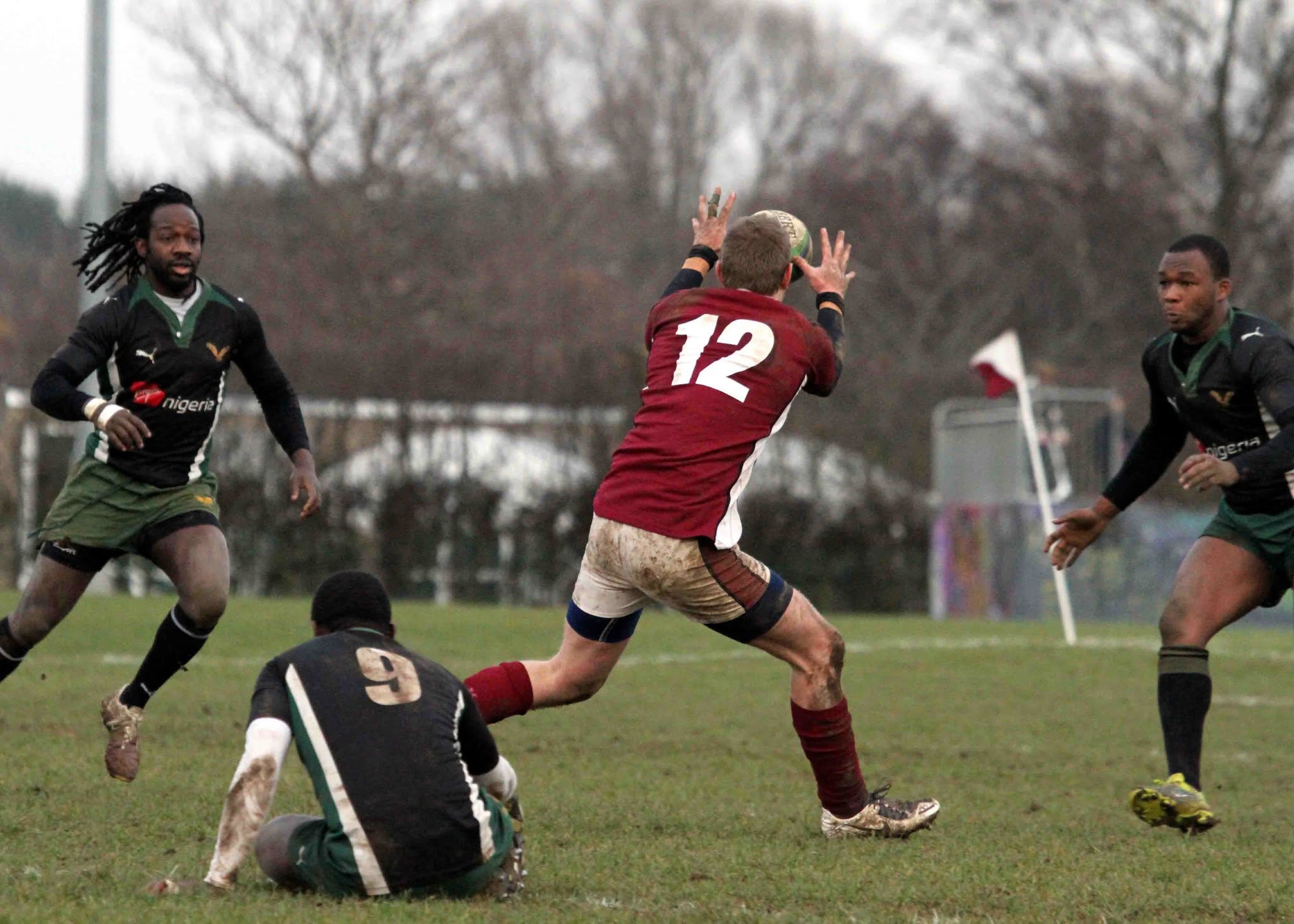
When you look at the headline photo above this article you see no. 12 about to catch the ball a split second before he is “smashed” in a double tackle from my teammate, Ali Shelleng, and me. Things do not look good for him.
What the picture doesn’t show is 12 celebrating with his teammates less than 20 seconds later. In the intervening sequence, he swivelled his arms and torso as Ali collided with him, flicking a pass to the teammate on his right as I smashed into his back. 12 knew he was going to get hit hard and that it was going to hurt, yet he maintained the composure to take the double tackle on his own terms and ensure forward momentum for his team. Three passes later, they scored a try in the corner.
__________________________________
I was reminded of Francis Emeruwa and this principle in a recent one-to-one coaching session with a sales director who was dreading his next conversation with his CEO. Their differing views on client relationship management is a regular source of tension between them.
Due to unexpected technical difficulties at a major client installation, the company was facing a penalty that would reduce the total income from this project. Though this is a long-standing client and despite the specific project remaining profitable, the sales director was expecting the CEO to find a way to blame him for problems that occurred on the operational side of the business. He expected this because that has become the norm in recent interactions.
That is when I told him about my former rugby coach and advised him to take the tackle on his own terms. Rather than passively accept the pain that was coming his way, he should steel himself with the facts and figures – he should own the narrative rather than have one foisted on him. As my message registered, his body language relaxed. He broke into a broad smile as he realised he had the power to change the dynamic between himself and his boss.
Taking the tackle on your terms increases your chances of success: the likelihood that you come out of an adversarial situation with an advantage. In response to the USA’s military attack, the Iranian government executed its own swivel of the hips by taking control of the Strait of Hormuz. It has suffered significant damage but it has thrown its attacker off-balance and wrested control of the narrative.
Much like heavy contact is unavoidable on a rugby pitch, conflict is unavoidable in the workplace. Learn to take tackles on your terms and you will become far more adept at dealing with conflict at work.
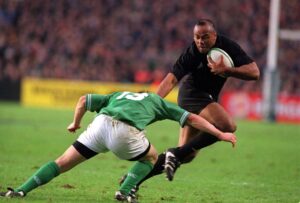
Just ask Jonah Lomu.
Jonah Lomu “rides” Brian O’Driscoll’s tackle
You’ll find more nuggets like this here.